Naturally, I thought of you.

Scott
Show her the Four and Five Tin Tins.
And the Recipes.
Hang In There Susan!!
Naturally, I thought of you.
FOUR PIECE BED SET - $265
There’s nothing cosier than being packed in like sardines. Dream of catching a big fish as you sleep amongst your new friends. You can pull up the doona cover over you so are inside the tin. The best bit is, these sardines don’t smell!
Sardine Tin Bed Toppings are made with beautifully soft 100% 200 Thread Count Cotton.
Sardinas Cuca en aceite d oliva
Serrano ham, Cabra al Pimenton goat's milk cheese, morcilla de arroz (blood sausage) a little can of little olives, white anchovies, Valencianos artisanal crackers, a sixer of Estrella Galicia and a bottle of Muga Rioja rose. I'm also making up some patatas bravas.
Not a common tin around these parts. I haven't had one that I remember.[es-keh-BEHSH]Escabeche is a typical Mediterranean cuisine which refers to both a dish of poached or fried fish (escabeche of chicken, rabbit or pork is common in Spain) that is marinated in an acidic mixture before serving, and to the marinade itself. The dish is common in Spanish, Salvadoran, Panamanian, Peruvian, Philippine, Puerto Rican, Dominican, Mexican and Guatemalan cuisine, and popular in Catalonia, Portugal and Provence. Influences of the dish appear as far as Asia-Pacific with adjustments to local food staples. It is usually served cold after marinating in a refrigerator overnight or longer. The acid in the marinade is usually vinegar but can also include citrus juice. Escabeche is a popular presentation of canned or potted preserved fish, such as tuna, bonito or sardines. wiki
So, the same order, top to bottom, as in the pic and descriptions above.
We followed this with the Cuca (top of the stack), staying with the olive oil before we ventured into flavors unknown. Three giants. Skin, bones, and slimy internal organs?
These didn't get any better from there. They were mushy and had a bad funk that demanded immediate removal from the table. The lack of evisceration might have fouled this tin. The Spanish Crackers cleansed the palate and the blood sausage made it happy again. Zero Out Of Five Tins
The serrano ham tastes like it's plastic packaging.
Paco Lafuente passed it. Four out of Five Tins.
These were not the Euro Crème de la Crème. But a fine dinner and discussion they did make.
This tin cost 790 pesos which is top dollar no matter where you are.
VigilanteAn interesting package got even more interesting when I noticed Serie Limitada on the back of the box.
And then found a fun and thought out tin inside the box. Their Centennial Range.
Plated up with Gamesa Saladitas, La Costeña Rajas, mexilimes and Totopos de tortilla de maíz.
Also some frozen Hornitos and tins of Tecate.
Their website shows History and Tradition, a Sustained Push, and a Calendar of Catches. They are thinking hard and doing good work over in Spain.
But damn, put it on a salty cracker, add a pickled chile jalapeño and a squeeze of mexilime and it's delicioso. I wanted to go 3 point 5 but shit, I'm in Cabo, Cuatro Fuera de Cinco Latas. I hope they show up in the States.
Little Sumpin Sumpin from The Sardine King.
February 21, 2010
GUY RAZ, host:
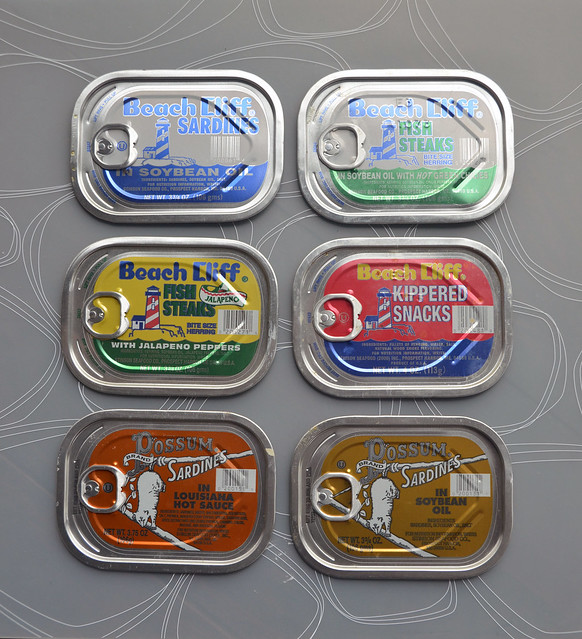
The town of Prospect Harbor, Maine, sits across the water from Acadia National Park. It's a small, down-east fishing village, known in the region for its sardine cannery, Stinson Seafood.It's the last sardine cannery operating in the United States. It's been around for more than a century. And if you drive down the main street in Prospect Harbor, you're likely to see a large sign in the shape of a fisherman holding a can of Stinson's signature product: Beach Cliff Sardines.
This week, Stinson's parent company, Bumblebee Foods, said that because of federal limits on herring catches, the plant was no longer economically viable. They plan to close the cannery on April 18. The plant's a hundred and twenty-eight employees will lose their jobs.
One of those is plant manager Peter Colson. He's been with Stinson for 39 years.
Mr. PETER COLSON (Plant Manager, Stinson Seafood): That's on the payroll. I started before I was old enough to be on the payroll, working in the plant. I would do other odd jobs just to try to make some extra money by selling dents, which is dented product that can't be sold on the market, which I would buy for eight cents a can and sell them for 10 cents a can and make two cents.
RAZ: And how did you even get into the business in the first place?
Mr. COLSON: Well, my father was vice president of operations. At that time, he was plant manager of the facility. We kind of grew up in the business. I'd watch what he was doing and just was interested in how the people get along so well together and work together as an industry.
RAZ: Now, you've been there 39 years. What did you think? How did you react when you heard that the plant was shutting down?
Mr. COLSON: Well, the first thing I thought of was the people that I've worked with for so many years. We have one lady here that's worked here for 54 years. I've also handled parties for two ladies that worked here for 60 years. There's a lot of camaraderie around here that people don't want to leave once they get here.
RAZ: Is Stinson the biggest company in town?
Mr. COLSON: Yes, it is.
RAZ: The cannery has been in operation for at least a hundred years, right?
Mr. COLSON: That's correct.
RAZ: What is the building like?
Mr. COLSON: Well, we've done a lot of renovation. In 1968, the plant burnt down, and within a year, the Stinson family had put together a more-modern facility using concrete and steel, and they've made this into a very nice-looking operation.They modernized the equipment. Back years ago, when I first started, you'd need a hundred packers to cut the heads and the tails off with scissors. Now, we have automated machines that will cut the fish. What we used to use a hundred packers for we do with 20 packers, and they lay the fish in the can, already pre-cut.
RAZ: I understand this is the last sardine cannery in the United States.
Mr. COLSON: That's correct.
RAZ: In the country.
Mr. COLSON: Yes.
RAZ: Where have they gone? I mean, who's canning sardines?
Mr. COLSON: New Brunswick, Canada, will produce the remaining amount of sardines that are produced in North America. They're also produced in Europe and South America as well.
RAZ: Peter Colson, what are your plans? I mean, after the plant closes on the 18th of April, what will you do?
Mr. COLSON: Well, I have to facilitate the closing of the facility and make sure that we can, you know, relocate the people is my biggest concern. And then I don't know if I'm going to I would like to maintain my lifestyle in the town of Prospect Harbor, but we'll have to wait and see.
RAZ: That's Peter Colson. He's the plant manager of Stinson Seafood Company. It's the last-standing sardine cannery in America. It's set to close in mid-April. Peter Colson, good luck to you.
Mr. COLSON: Thank you very much.
Transcript provided by NPR, Copyright National Public Radio.
Three Threads Porter, quite tasty and brewed just over to my right!
They only looked at me sideways for a second when I asked for the lid to the tin. Then realizing quickly it was Matiz (already reviewed here), asking for the box (notice their use of the word tinned).
Look at that!! Society Style and Everything!!
You Tell Them How TheycankeepafewTinsontheshelfforYouandwhenYoureturnYouwillgetonewith"toast&marketaccompaniment"!!
Welcome to the Society.


I didn't get it till later for one reason or another and then we were home together and I just couldn't understand: After all these years, After all these Tins, After all these beers, After all these Wins, how could she not bring it on home. (Wait. Stop. Watch that last link. Kick it up to fullscreen. 1970. At 3:23 tell Jimmy Old Nevermore wants his jeans back. At 6:05 tell Jimmy I want my mind back. watch out, watch out now.)
They are expired.
P.K. Food Corp., located in San Leandro, California was established in 1996 as a food importer and rice distribution conduit from Thailand to the United States. Business began with Asian trade in the Bay Area, but soon expanded to other Asian Markets in Hawaii, Houston, Los Angeles, Seattle, and New York.
The Majestica Brand was created and lauched with Family Dollar, Sam's Club, Wal-Mart, and Western Food Products (Shop Rite). The business necessitated the opening of warehouse facilities in Newark, Baltimore, Atlanta, Reno, Seattle, and the home office in San Leandro.
Today, the PK Food product line offers a variety of the very best from Thailand, including long grain Jasmine rice, parboiled rice, fruit products, seafood in cans, and cracker salads.
The hot sauce sardines had potential, the mustard kinda blech. Send flowers to Oakland Medical Center Room 666.